




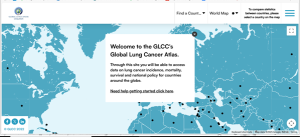
The Global Lung Cancer Coalition has launched its updated E-Atlas, which is a unique tool offering a global snapshot of lung cancer data and policy.
If you are looking to better understand lung cancer within and across countries, the revised E-Atlas offers insights from six key indicators:
- Incidence
- Mortality
- Survival
- Existence of a national cancer plan
- Existence of a cancer registry
- Implementation of the WHO Framework Convention on Tobacco Control
The E-Atlas enables users to explore and compare data across countries, helping advocates, researchers, and policymakers to identify gaps and drive change.
Why data on lung cancer matters
Data plays a critical role in motivating political action, informing policy decisions and ensuring accountability across all forms of healthcare.

Knowing the importance of data, the GLCC created the E-Atlas in 2014 to highlight the variations in lung cancer rates across the world. The tool aims to give members and policymakers alike the data they need to drive reductions in lung cancer rates.
The E-Atlas brings together lung cancer statistics for countries around the world and is open for anyone to use. In the decade since it was first published, it has had several updates, most recently in September 2025 to ensure alignment with the newest available GLOBOCAN dataset (2022).
Exploring the data from the most recent update we can see that the global political momentum of the past few years on lung cancer has not yet unanimously carried through to changes in incidence and mortality.
For example, while Denmark has seen a steady decrease in both incidence and mortality, India by contrast has seen a rise in both (despite still having less lung cancer overall than across Europe/North America). While data of course only provides a view as to what is happening, and we need to pair this data with policy changes and wider social trends to understand why this is the case, this evidence provide an important point for reflection to inform further political action.
Comparing not only between years, but also across countries, the E-Atlas likewise allows users to look at trends across countries to better understand how different policies are impacting lung cancer rates.
It is our hope that alongside the renewed political commitments on lung cancer – including the recent World Health Organization resolution – Promoting and prioritising an integrated approach to lung health – this updated data can support campaigners and policymakers across the global drive positive changes in lung cancer.
To find out more about lung cancer trends in your country, please click here to explore the E-Atlas.